



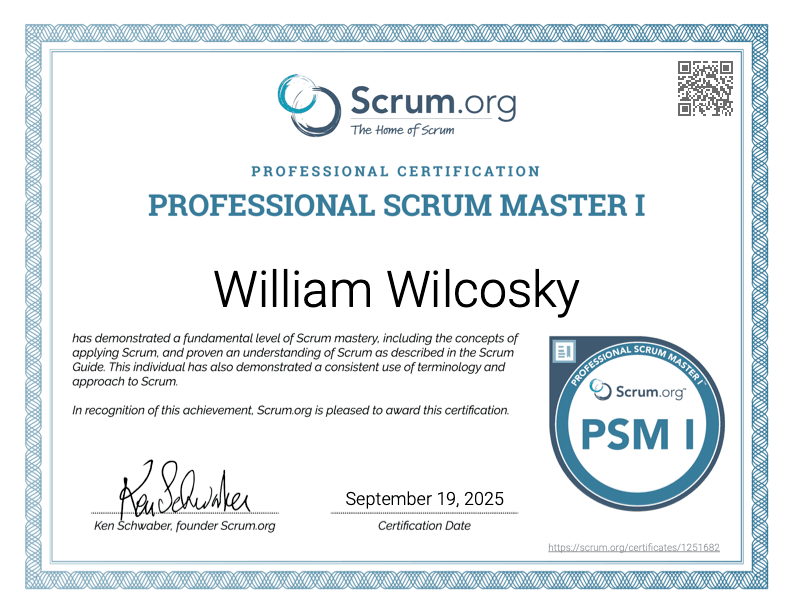
I now have the PSM I Scrum certification. The final assessment was more challenging than I thought it would be. The questions really force you to think critically; and fast to complete it in time!
As I’m learning more about Scrum I already see that in my previous posts on this topic, I included things that are Complementary Practices, and not actually a part of Scrum. For example, story points. Story points can help some teams, but are not required. Another example is something called Definition of Ready. A team might decide to implement this to gauge which Product Backlog items are ready for a Sprint. However, with any Complementary Practices, use caution. If any added practice slows down progress, it could be a sign that the team shouldn’t worry about using that particular practice.
To be clear, this does not mean that you can eliminate a core part of Scrum such as Definition of Done. Scrum is very flexible and you can make it your own so to speak, however, you must keep certain basics in place. Otherwise, it isn’t Scrum.
One of the parts you cannot eliminate is ensuring events are Timeboxed. Here’s a table that lists the Five Scrum Events and their Timebox.
| Event | Description | Required Participants | Timebox |
|---|---|---|---|
| The Sprint | A fixed length timebox within which the development work and the other Scrum events take place. | The Scrum Team and stakeholders | 1 month or less |
| Sprint Planning | The starting point of the Sprint where the Scrum Team collaborate to define the purpose of the Sprint, what they think they will work on and to create an initial plan. | The Scrum Team | 8 hours or less |
| Daily Scrum | A short alignment meeting for the Developers to check progress toward the Sprint Goal and re-align. | The Developers | 15 minutes or less |
| Sprint Review | The formal opportunity for collaboration between the Scrum Team and the stakeholders to review progress towards the Product Goal and incorporate new information or learning. | The Scrum Team and stakeholders | 4 hours or less |
| Sprint Retrospective | The closing event of the Sprint where the Scrum Team reviews their working practices and identifies improvements to implement in the future. | The Scrum Team | 3 hours or less |
This is just one of the many fantastic things about the Scrum Framework; the fact that you aren’t wasting time; there are maximum lengths of time for every major event. It could seem like a small detail, but I think it’s a big deal because teams sometimes struggle with how long certain events or meetings should be.
Next I plan on eventually studying for and obtaining the level 2 certification and unless my life changes drastically, I’ll continue until I have all of the major Scrum certifications. Whether or not I am ever an actual Scrum Master at a company, the skills I’m learning are a net positive and transferrable to all kinds of roles.
This is my favorite project management-type framework by far.
I may or may not continue to blog about Scrum. My goal was to write a few blog posts as I was studying to reinforce certain concepts in my mind and knowledge share. But, going forward I don’t want to feel forced to share everything I’m learning about Scrum. If I feel like it I will. Otherwise, maybe I’ll blog about cats or string theory next. We’ll see.
 Share this post on social media.
Comments
No comments yet.