



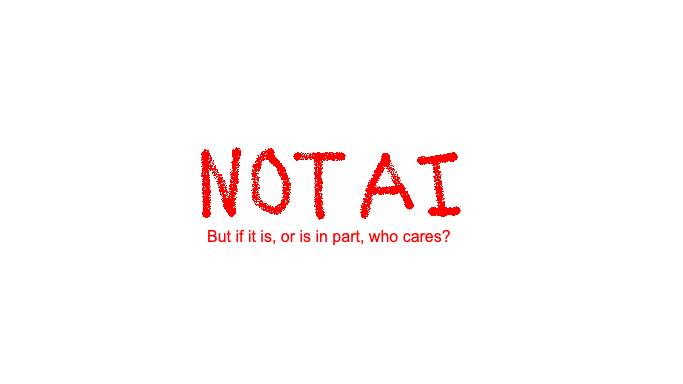
I was banned for 30 days from a web developer community that I had just joined the same day on Discord. The reason was because I responded to a question with a mixture of my own words and some AI generated details to be as detailed, accurate, and helpful as possible. The moderator called it AI slop, and I replied and said they were, “being silly,” and so the moderator executed the bad. So also, remember not to call moderators silly. It’s very scandalous.
It wasn’t AI slop. It was a carefully crafted reply to throughly answer another member’s question. Banning due to disliking AI is wrong, but fits the vibe of some web dev communities (unfortunately).
To understand why I think this is wrong, yet not surprising, and why myself and others might provide in depth, even partially AI supported responses, you first need to understand an issue that started prior to LLM AI. It’s something in dev culture that may be rarely discussed unless you’ve felt it firsthand:
The whole “Google it. Read the docs. Figure it out.”
On paper (or screen), it seems reasonable. Self-sufficiency is important. Nobody wants to spoon-feed answers forever. But in practice, it often lands like a door slamming in your face.
Because “just Google it” assumes you already know what to Google. If you don’t know the terminology, if you can’t spot outdated results, or if you’re unsure what part you’re misunderstanding, you can spend hours circling the problem. It’s not laziness to ask questions in a dev community. Even basic ones. It’s being lost and why people join these communities.
Side note: Stack Overflow was always the biggest offender. One could Google, search Stack Overflow, somehow miss the answer because… human… and then you quickly would have your post removed for being a duplicate or being something the moderator didn’t like.
Many developers forget that phase. Or maybe they survived it and now think everyone else should too.
Some, however, remember it vividly. Clicking result after result, reading answers that assume knowledge they didn’t have, feeling stupid for not getting what seemed obvious.
When those people (people who were dismissed and not helped in the past) finally understand something, they don’t just drop a link and vanish. Or, say, “search the web.” They explain. They might over-explain. They try to fill in the gaps they once fell into. They write the answer they wish someone had given them.
It can look wordy. It can look like too much. With AI in the mix now, it can even look suspicious. But often, it’s someone intentionally trying to help.
Sometimes that includes a bit of copy-paste. Yes, even from AI chats. Not to cheat or seem smarter, but because maybe they knew the basics but wanted to make sure they expressed the solution exactly correct. So, they quote it, then add their own interpretation… plain-language translation, examples, context… because they want to help.
There’s an irony here: people were told for years in web dev communities to “Google it,” and when they return now with a synthesized answer built from multiple sources and/or AI, it’s frowned upon because it “looks like AI slop.” But effective research is a blended understanding. A portion of AI assistance doesn’t erase care or authenticity. A portion of AI assistance isn’t AI slop. It’s a careful, detailed answer which could help hundred/thousands that visit the community.
Furthermore, some people just don’t communicate in short bursts (or without capitalization or punctuation). Some are non-native speakers, anxious about posting, or being careful not to get roasted. Which again is common in certain web dev communities. In other words, AI related bans are also wrong because the person truly may not have used AI. Maybe they like using correct grammar. And if they did use AI, so what. They are helping someone.
Of course, there’s a line: irrelevant walls of text, super generic answers, bot spam… of course nobody wants that. But not every detailed and grammatically correct post is slop.
Good dev communities aren’t built by shaming questions or answers. They thrive when people aren’t afraid to ask, when experienced folks remember they were beginners, when helping or being helped isn’t a burden.
The goal shouldn’t be to force everyone into the same communication style, or banning AI. Some answers will be short and sharp; some long and hand-holding; some formal, some casual. Some with AI assistance. All ways of communicating can be valuable. So, the goal should be people helping people.
In the end, I’m saying people who weren’t helped in the past might go a little overboard at times and try to help in detail, with or without AI.
More spaces could use that energy.
It’s sad that hobbyists or even experienced developers sometimes have to deal with, “Google it,” and now “no AI slop,” too.
I know moderators are often volunteers and used to tons of spam. But, I’ve always thought that there has to be a better way. More moderator training, or just more understanding or tolerance.
 Share this post on social media.
Comments
No comments yet.